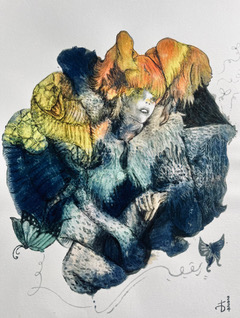
Donna Turan, the artist behind Lady Reborn Art, creates powerful paintings that explore themes of transformation, identity, and emotional depth. Her work captures raw emotions, ranging from expressive animal portraits to self-portraits that illuminate the spectrum of human experience: freedom and confinement, clarity and chaos, and the highs and lows of living with bipolar disorder.
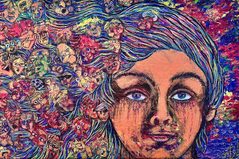
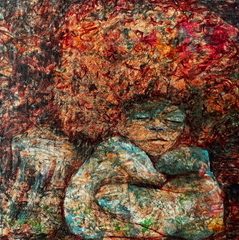
Her work often features expressive brushwork and a vibrant color palette, bringing a dynamic energy to each piece. For instance, in her self-portrait “Run a Brush Through That Hair” the swirling, fragmented strokes that make up the figure’s hair are chaotic and multidirectional, creating a storm of color, faces, and forms. These vigorous strokes suggest mental overwhelm, as if thoughts and memories are spiraling uncontrollably. The hair, rather than being a passive element, becomes a psychological space filled with noise, conflict, and suppressed trauma—each face representing a different emotion or internal voice.

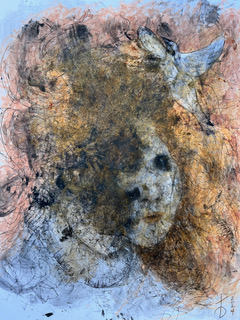
Donna’s paintings often blur the lines between realism and abstraction, inviting viewers to explore the underlying emotions and stories. Her brushstrokes are deliberate and textured, adding layers of complexity to her subjects. This technique is evident in works like “Innocence Lost,” where the interplay of light and shadow, combined with nuanced color transitions, evokes a poignant narrative of lost purity.

Overall, Donna’s art captures the complexities of the human experience, using her distinctive painting style to create works that are both intimate and universally relatable. In an interview below, she explores the profound connection between her emotional world and her creative practice. Through reflections on inspiration, mental health, and the transformative power of art, she offers a raw and compelling look into the inner life that shapes her work.
How does your mood influence your painting process?
My mood shapes how I approach a painting — the pace, the palette, and the subject matter often shift depending on my emotional state. Some pieces emerge with layered complexity, others through simplicity and restraint. I allow my process to be intuitive, letting each emotion take up space without needing to explain or edit it. Normally I am working on 3 to 10 pieces simultaneously, although some never see completion.
Where do you find inspiration for your work?
I find inspiration in the internal and invisible — emotional landscapes, identity, memory, and the tension between how we feel and how we’re perceived. Much of my work is shaped by lived experience: I am a survivor of sexual assault, raised with strong moral convictions and an innate drive to defend what is just and right. As an empath, I often absorb and process the emotions around me, which deeply influences the tone and symbolism in my work. Nature is also a vital source of inspiration — I live in the woods, surrounded by quiet, organic forms and shifting light. The natural world provides grounding, clarity, and metaphor, often finding its way into my palette and compositions. Themes like duality, transformation, and vulnerability are central to my art. Inspiration can emerge from conversation, silence, mythology, or moments of deep self-reflection — anything that stirs the hidden or unspoken.
How long have you been creating art, and how does that journey relate to your mental health?
I’ve been creating for as long as I can remember, but I made the decision to pursue art full time three years ago after experiencing great personal loss as a victim of financial crime. At the time, I was working within the court system — a place where I hoped to make a difference — but I found myself feeling powerless, especially as my own legal case was being ignored nearby. That disconnect between my desire to help others and inability to do so, and the system’s failure to help me became too heavy to carry. My need for justice and expression became overwhelming, and I finally gave myself permission to follow the path I had always dreamed of. Creating art has since become both a lifeline and a way to reclaim my voice.
When do you experience your most creative bursts?
Creative bursts tend to come in waves. Sometimes they arrive unexpectedly, sparked by a visual, a feeling, or a sudden clarity. Other times, creativity builds slowly, through repetition and quiet persistence. I try not to pressure inspiration but instead remain open to it in whatever form it takes.
Are there specific paintings that best represent your mental health, and why?
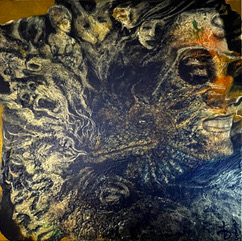
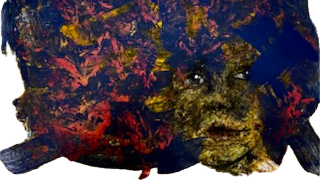
Yes — Self Portrait in Shades of Bipolar captures much of what I experience internally. It reflects the complexity, beauty, distortion, and strength that are all part of living with bipolar disorder. The haunting faces and layered textures symbolize introspection and the weight of perception — both internal and external. The dragon-like figure woven into the chaos represents the power of transformation and resilience. This piece is as much about how others see me as it is about how I see myself — the projections, assumptions, and misunderstandings that often accompany mental health conditions. It challenges the viewer to confront those layers.
That said, all of my self-portraits are deeply meaningful to me. Each one offers a different lens on my identity and emotional truth, marking specific moments in my journey of self-understanding and expression.
What advice would you give to other creatives living with bipolar disorder?
Let your creative process be whatever it needs to be — there is no wrong way to make art. You don’t have to be “inspired” or at your best to create something meaningful. Trust that your perspective is valuable and that your expression, in all its forms, has the power to connect and heal — both yourself and others. The final result is less meaningful than the process. Don’t create for an end result – just create for the moment.
All copyright of images belong to Donna Turan
You can explore more of Donna’s artwork on her website at www.ladyreborn.art.
 BE
BE 